Ingredients
A journey through the agarwood forests of Laos and Cambodia, where the world's most precious aromatic wood is harvested with extraordinary care.
There is no such thing as a healthy oud tree. That sentence is the first thing a buyer learns, and it takes some time to accept, because it inverts every instinct about agriculture. The aromatic resin the world calls oud, agarwood, or oudh does not exist in an unharmed Aquilaria. It is a wound response, the tree's answer to a mould infection that begins in a break in the bark and spreads slowly through the heartwood over years.
An uninfected Aquilaria is pale, light, almost worthless. Where the infection takes hold, the tree floods the affected tissue with a dark, dense resin to seal it off. The wood there turns from cream to caramel to near-black, and grows heavy enough to sink in water, which is why the finest grade has been called chén xiāng, sinking incense, in Chinese sources for well over a thousand years.
The process cannot be rushed. A commercially interesting infection takes eight to twelve years; the pieces that make collectors travel are the product of decades. In wild forests, perhaps one tree in a hundred carries any resin at all, and only a fraction of those carry it in quantity.
Every gram of wild agarwood represents a specific tree, in a specific place, that suffered a specific injury at a moment nobody witnessed.
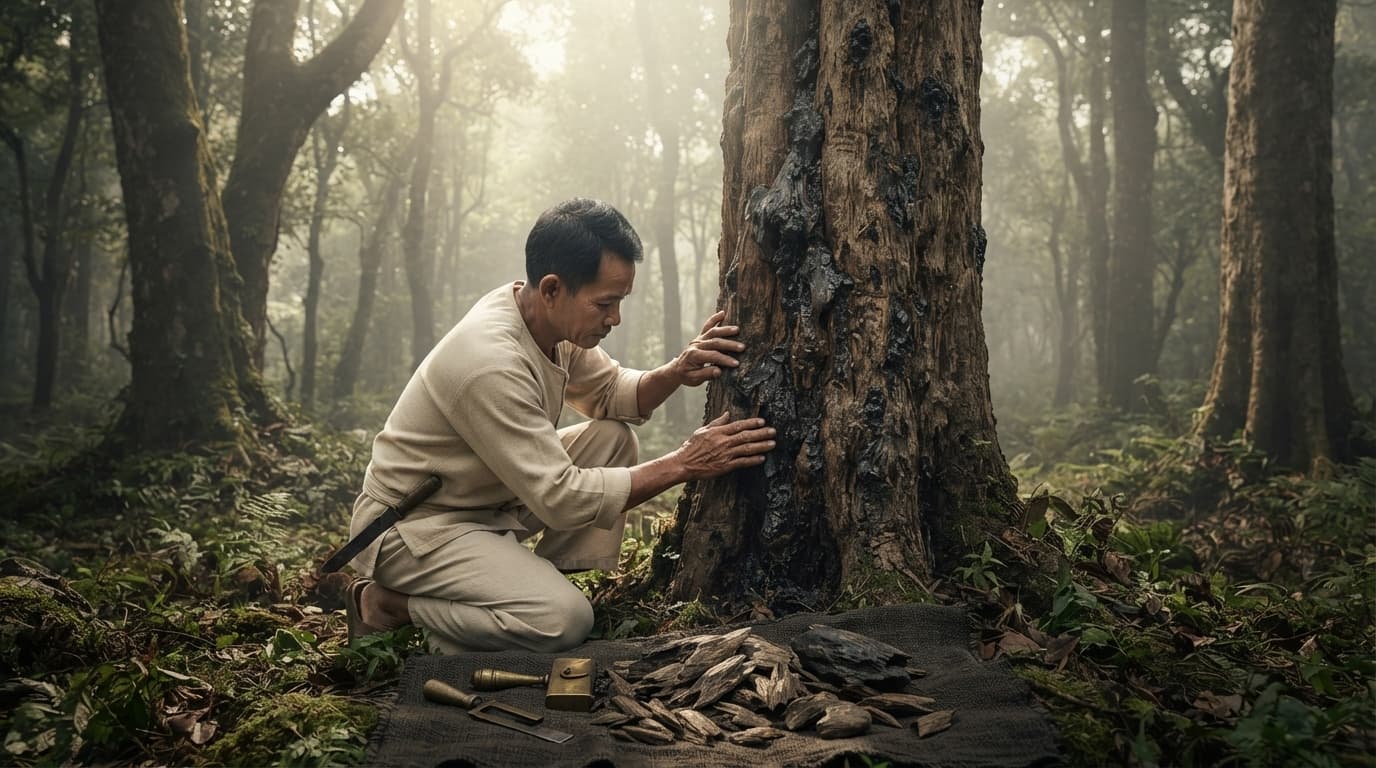
We buy in two places. In the mountains of Laos, harvesting is still largely a family occupation: a man who learned from his father which slopes hold infected trees, who carries a small axe and takes a section rather than the trunk, and who can tell by the sound of the blade whether the wood beneath is worth opening. In Cambodia, plantations now supply the majority of the market, trees deliberately inoculated at eight or ten years old and harvested on a schedule.
Plantation oud is not inferior by definition. It is different: cleaner, more uniform, less complicated. Wild Laotian wood carries a barnyard edge, a leathery, almost fermented note that a novice reads as a fault and an experienced nose reads as depth. What the plantations have genuinely delivered is a supply chain that does not depend on stripping a forest, and Aquilaria has been on CITES Appendix II since 1995 for reasons that were entirely earned.
The wood is soaked, sometimes for a week or more, then ground and distilled traditionally in copper deg over a wood fire, increasingly in steel with steam. A single kilogram of high-grade chips yields a few millilitres of oil. The first distillate is sharp and green; the character everyone is paying for arrives in the later fractions, hours in, when the still is barely producing.
Rushing the fire ruins it. Heat too high and the oil takes on a burnt, acrid quality that no amount of blending will lift back out. A distiller who has spent three days on a batch will not risk the fourth to save an afternoon, and this is why the best material comes from people who are, temperamentally, unhurried.
Fresh oud oil is not finished. Left sealed for a year, two years, five, it loses its rawness and gains a rounded, resinous sweetness that cannot be manufactured. Houses that hold stock hold it for this reason, and the oldest bottle in a distiller's cabinet is usually not for sale at any price.
We hold our Laotian material for a minimum of eighteen months before it enters a composition. It is capital sitting still, which is a difficult thing to justify on a spreadsheet and an easy thing to justify with a blotter in each hand.
The temptation with a material this expensive is to announce it to build a fragrance that shouts its own ingredient list. Oud rewards the opposite approach. It is a base note of enormous persistence and very little subtlety, and used at full volume it flattens everything above it.
In our compositions it sits underneath, at a concentration most buyers would consider modest, doing the work that resin has always done in Egyptian perfumery: holding the structure together and giving the volatile materials above it something to rest on. You are meant to notice it late, on the second wearing, as the reason the fragrance is still there at midnight.
Continue Reading
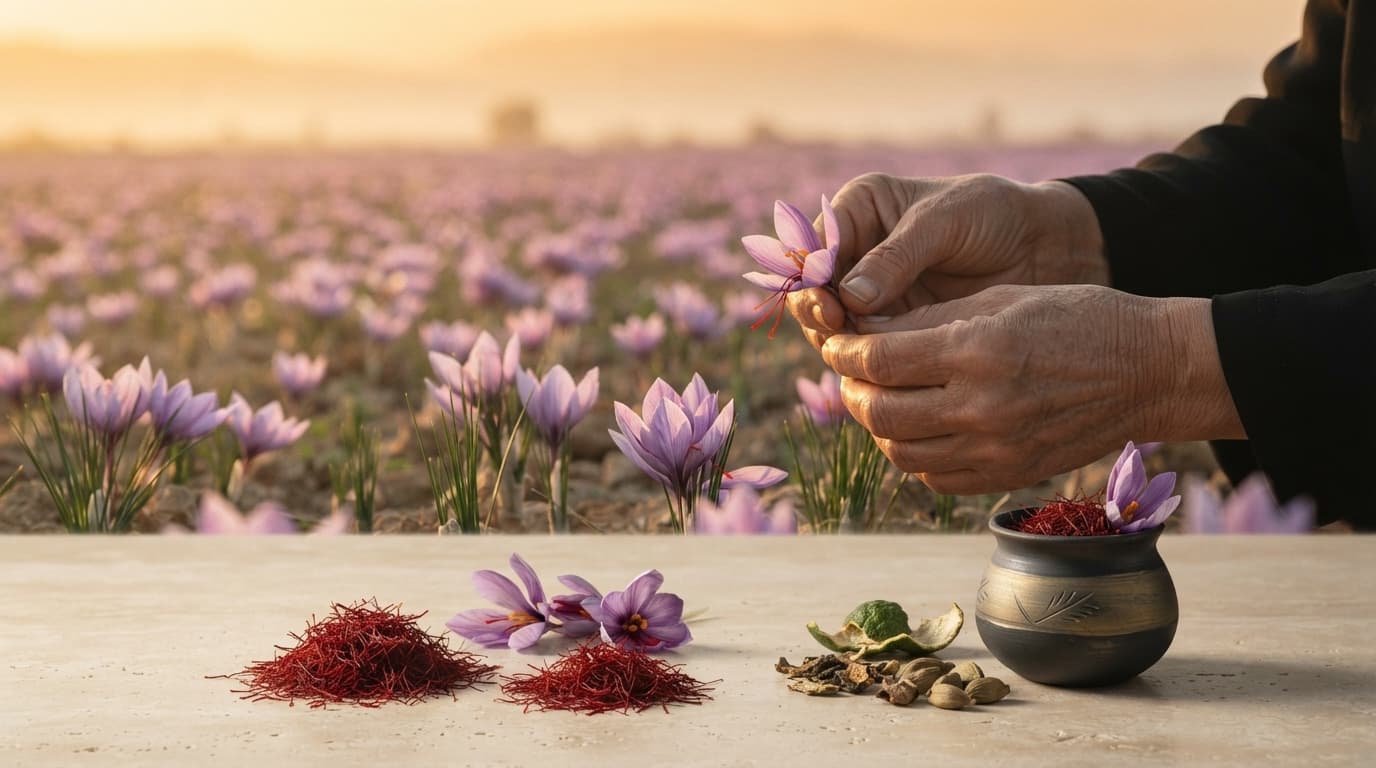
A gram of saffron requires 150 flowers, each hand-harvested at dawn. We trace the journey of this extraordinary ingredient from the Iranian plateau to our atelier.
How a civilization 5,000 years old developed perfume formulas so sophisticated that modern chemists still struggle to fully replicate them.
With the help of Egyptologist Dr. Amira Soltan, we decode the scent formulas carved into the walls of the Temple of Edfu.