Heritage
With the help of Egyptologist Dr. Amira Soltan, we decode the scent formulas carved into the walls of the Temple of Edfu.
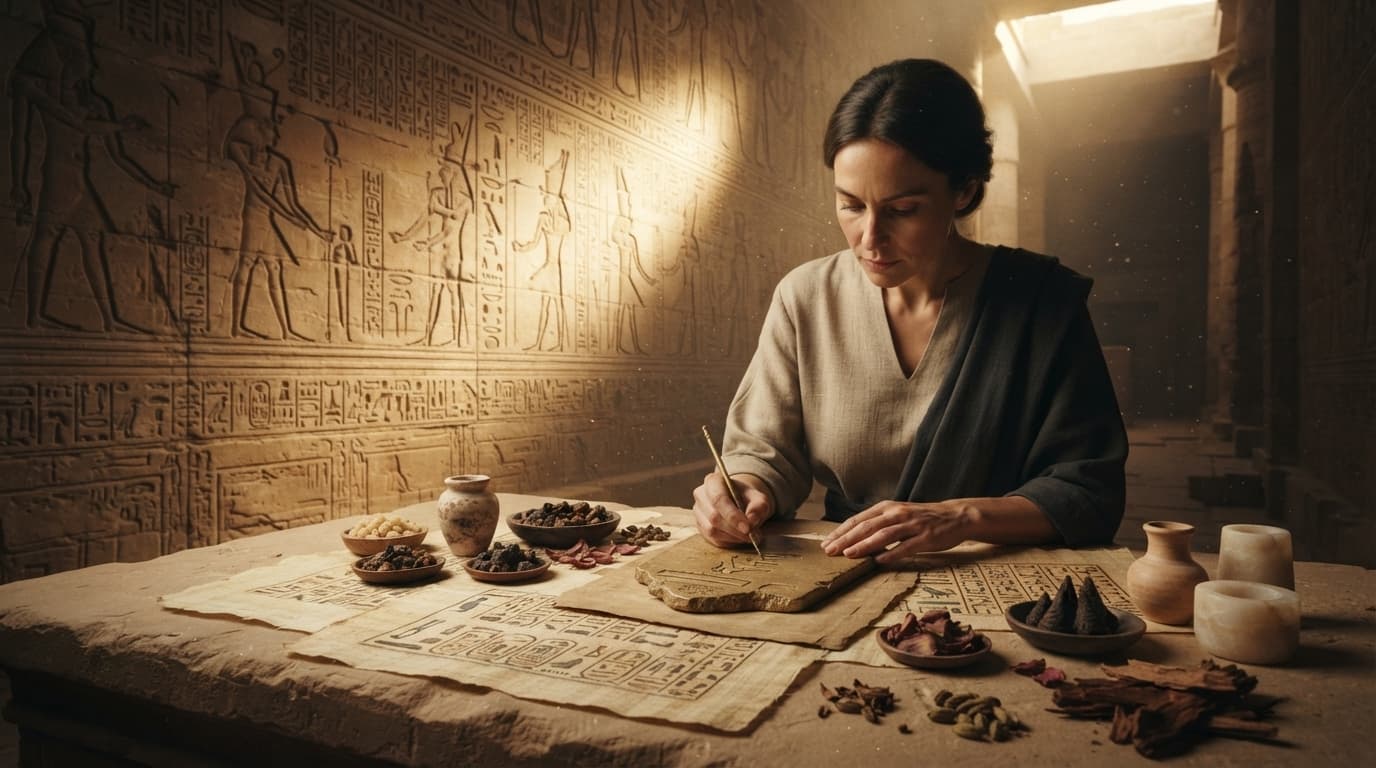
The perfume laboratory at the Temple of Edfu is a small room, roughly four metres by three, off the southern corridor of the sanctuary. It is not much to look at. What makes it one of the most remarkable rooms in the ancient world is that its walls are covered, floor to ceiling, in recipes.
We spent four days there with Dr. Amira Soltan, an Egyptologist who has worked on the Ptolemaic temple texts for two decades, trying to answer a question that turns out to be much harder than it sounds: what did these formulas actually smell like?
The inscriptions are procedural. They name materials, give quantities, specify sequence, and state the vessel and the duration. In form they are closer to a pharmacopoeia than to a poem, which is itself significant: these are working documents, carved permanently because the knowledge was too valuable to trust to papyrus.
Several complete formulas survive at Edfu, including versions of kyphi and of the sacred unguents used to anoint cult statues. The quantities are given in hin and fractions of hin, a volume measure of roughly half a litre, and the proportions are internally consistent across texts recorded centuries apart at different temples.
These were not local traditions. They were a standard, maintained across a country, over a period longer than the interval separating us from the Roman Empire.
Here the difficulty begins. A recipe is only as useful as your ability to identify what it lists, and Egyptian aromatic vocabulary resists translation with remarkable stubbornness.
Some terms are secure. Antyu is myrrh, or a class of myrrh-like resins; sntr is frankincense. Others are contested in ways that change the result completely. Tj-shps is variously rendered as camphor, cinnamon, or an unidentified aromatic bark from a tree no longer growing in the region. Nkftt may be a resin, a flower, or a preparation rather than a raw material.
Dr. Soltan is careful about this in a way that reconstructions in the popular press are not. "We can be confident about perhaps sixty per cent of any given formula by weight," she told us in the corridor outside the laboratory. "The remaining forty per cent includes materials that, if we have them wrong, would change the character entirely. An honest reconstruction says so."
Where the vocabulary fails, the verbs help. The texts are unusually specific about process, and process constrains the material.
A substance that is ground before combining is a solid resin, not a gum. A substance left in wine until it swells is a dried fruit or a bark, not a flower. Something that is added last, when the vessel has cooled is volatile and would be destroyed by heat, which narrows it to a small family of possibilities regardless of what its name meant.
This is how the reconstruction actually proceeds: not by translating a word list, but by asking what class of material would behave the way the text says this one behaves. It is slow, and it produces ranges rather than answers, and it is very much more reliable than the alternative.
Several structural decisions in the Edfu formulas are unmistakable, whatever the ambiguities.
Resins dominate by weight, in every formula, without exception. The compositions are built to last and to be released by heat on skin, on a warm statue, over coals. Sweet materials are always present but never dominant; honey and dried fruit appear in quantities that round the resins rather than confect them. And in the longer preparations, maturation is not optional. Formulas specify rest periods of weeks. One specifies a full year.
A perfumer reading this recognises the shape immediately. It is a composition designed around fixation and time, by people who had thought carefully about both.
We came back with a great deal of material and one honest conclusion, which Dr. Soltan had offered on the first afternoon and which we spent the rest of the week confirming.
The Edfu formulas were made for a room, not a wrist. They were burned, or melted over a lamp, or applied to stone. Reconstructing one as a wearable perfume produces something that is at best a translation and at worst a misrepresentation a claim of authenticity that the chemistry does not support.
What we took from the wall was not a formula. It was a set of proportions, a philosophy of structure, and a reminder that the people who wrote it expected their work to be smelled two thousand years later.
Continue Reading
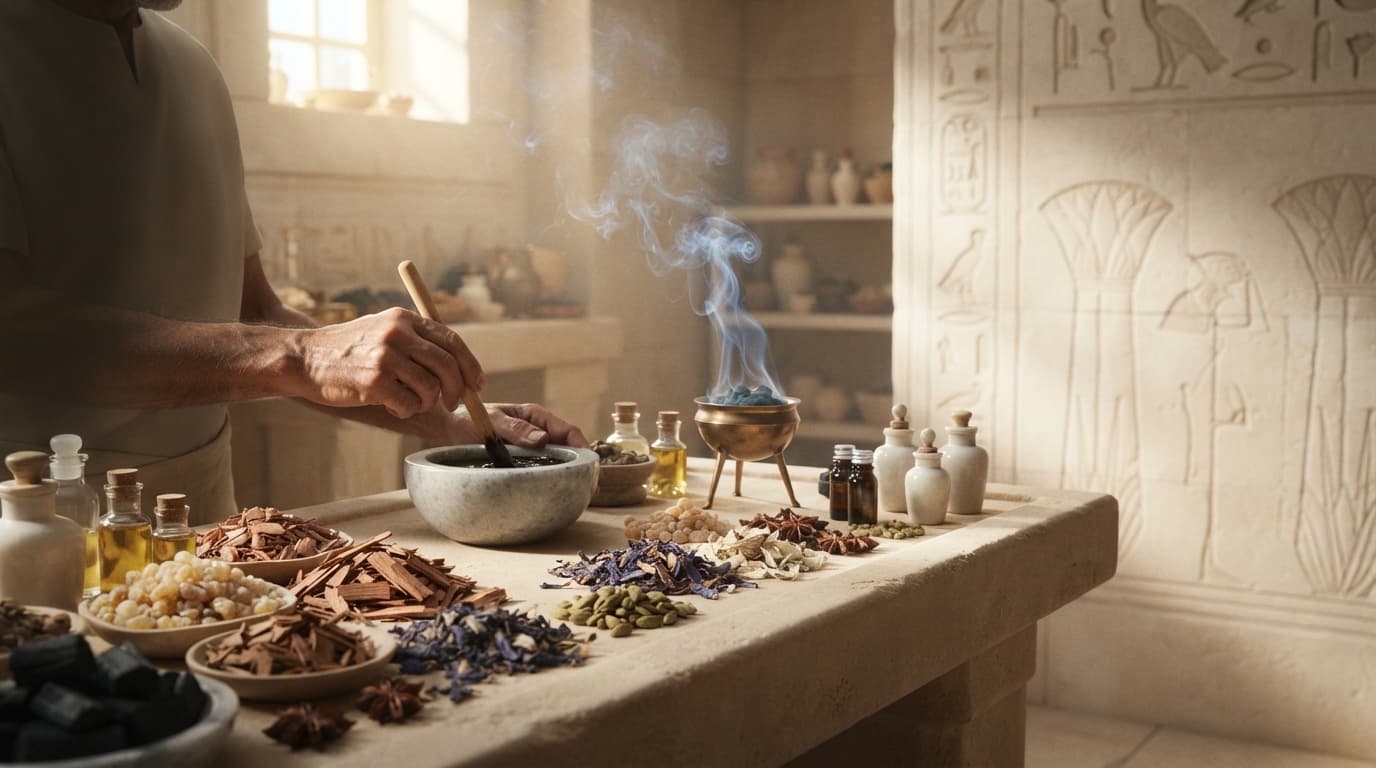
How a civilization 5,000 years old developed perfume formulas so sophisticated that modern chemists still struggle to fully replicate them.
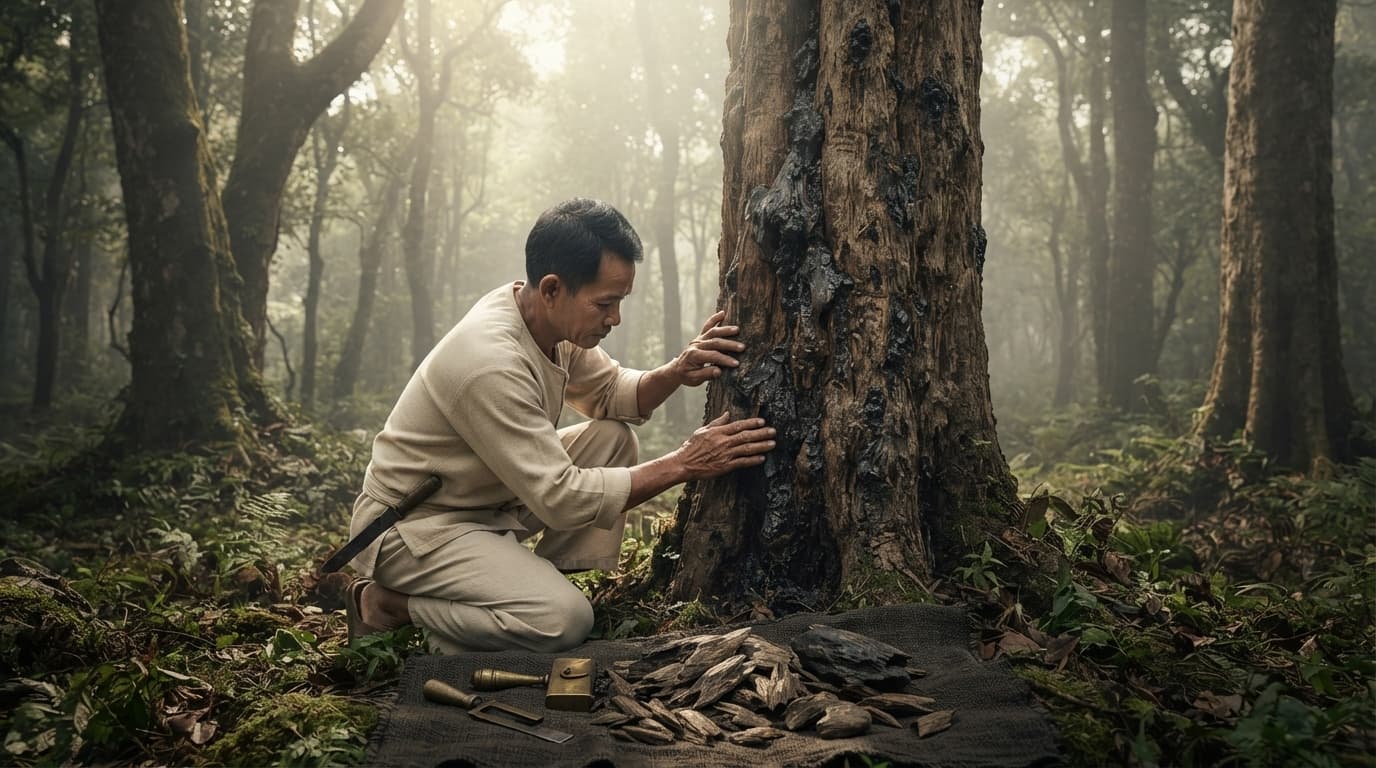
A journey through the agarwood forests of Laos and Cambodia, where the world's most precious aromatic wood is harvested with extraordinary care.
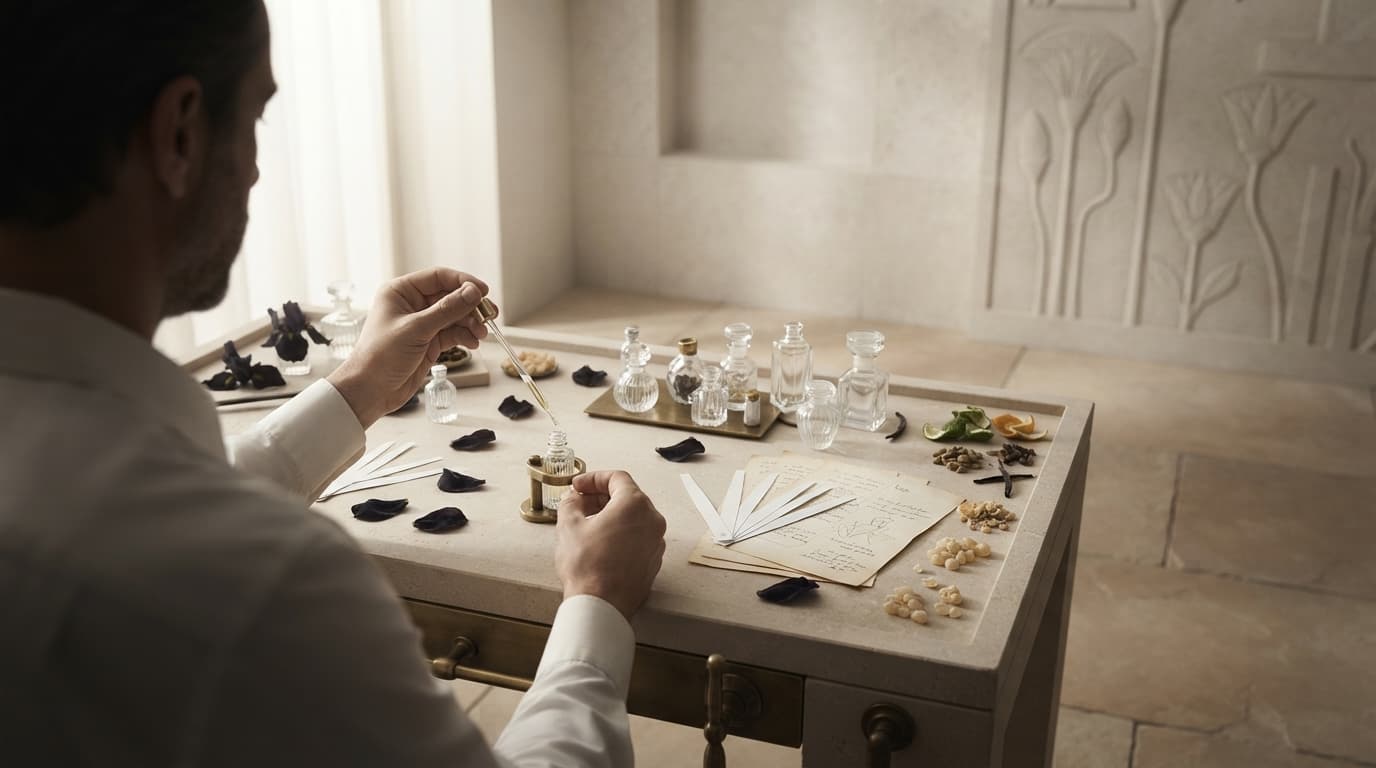
Master perfumer Mohamed Hassaan opens the doors of the KHEM atelier to share how our most complex fragrance took three years and 200 iterations to perfect.